Support +254 734 916745

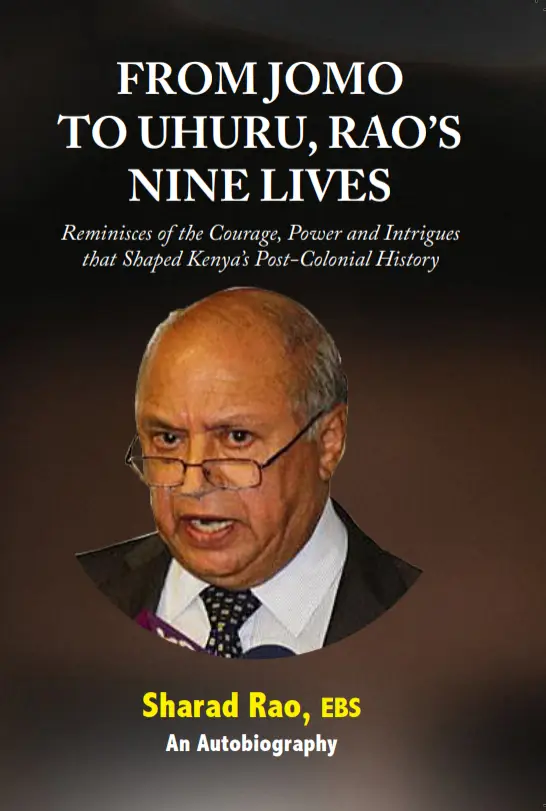
When Nairobi Shut Out Beijing: Sharad Rao Narrates Frosty Cold War Relations in Autobiography

By Elijah Mbalaria
Most historical material on Kenya’s foreign policy paint the country’s post-colonial era as a straightforward alignment with Western capitalism. However, in an autobiography titled: From Jomo to Uhuru: Rao’s Nine Lives, prominent Kenyan jurist Sharad Rao unearths a much more complex reality. Through an intimate first-person lens, Rao’s book serves a behind-the-scenes narration of Kenya’s deeply frosty posture toward Beijing during the late 1970s and 1980s, an era defined by Nairobi’s fierce wariness of communist expansion.
The Ideological Wall: Shutting Out China
Under both Presidents Jomo Kenyatta and Daniel arap Moi, the Kenyan government intentionally “shut out” China. Suspicious of its communist tendencies and anxious to preserve ties with Western capitalist powers, Nairobi maintained an icy distance from Beijing. This was perhaps a tactical departure from the non-aligned stance adopted by the wider African continent on the cold war.
Diplomatic Retaliation at the Airport
This paranoia inevitably spilled over into embarrassing diplomatic mishaps. Rao found himself at the very center of one such cold shoulder retaliation. After Nairobi left a Chinese Ambassador stranded at the airport due to official indifference, Beijing waited for the perfect moment to return the favor.
That moment came when a high-powered delegation from Kenya’s Sports Ministry arrived in China. In a calculated move of diplomatic payback, the Kenyan team was left holed up in an airport hotel with no sense of direction, completely ignored for hours until Chinese authorities and the Kenyan Ambassador finally retrieved them. The Kenyan Ambassador would later reveal to his compatriots that his communications with Nairobi were systematically intercepted by the Communist Party government.
The Kasarani Standoff and the Soft Loan Punishment
This mutual distrust directly jeopardized Kenya’s infrastructure ambitions. The delegation’s brief was to secure a grant from the Chinese government to build a national sports stadium for the upcoming All-Africa Games. As punishment for Nairobi’s frosty disposition, the Chinese authorities flatly refused the grant, remaining adamant on issuing a soft loan instead.
The diplomatic knot was so tight that it necessitated a personal trip by President Moi himself to smooth things over. Moi’s direct intervention finally thawed relations enough to pave the way for construction. The architectural byproduct of that high-stakes standoff stands today as the iconic Moi International Sports Centre Kasarani in Nairobi, which ultimately opened just in time to host the 1987 All-Africa Games.
Rao’s memoir is a brilliantly cites Kasarani as a monument to a volatile era, when Kenya navigated the treacherous ideological battleground between Communism and Capitalism.
The autobiography has rich material for researchers studying East Africa’s geopolitical alignments and Sino-African relations during the Cold War.
The writer is a research assistant at Free Press Publishers.