Support +254 734 916745

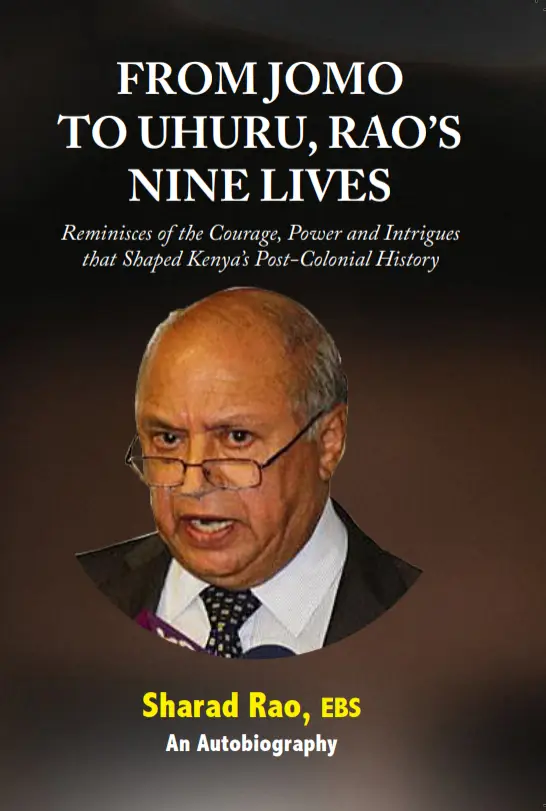
Sharad Rao’s Nine Lives: A Front-Row Seat to the Making of Modern Kenya

By Miriam Nyandika
Sharad Rao’s autobiography, From Jomo to Uhuru: Rao’s Nine Lives, delivers a colorful narration of Kenya’s tumultuous transformation from a racially segregated British colony into a sovereign, modern republic. Spanning four presidential administrations, Rao’s book is an authoritative, insider look at the political, legal, and geopolitical forces that shaped the nation.
Growing Up in a Segregated Colony
Rao’s journey begins with his family’s migration from India to East Africa, setting his childhood in 1930s Nairobi. Growing up in a strictly segregated society where Europeans, Asians, and Africans occupied rigidly enforced social tiers, his early years exposed him to the deep inequalities of British rule. This background anchored his later pursuit of law in Britain, returning home as a qualified advocate just as the tides of African nationalism and the Mau Mau rebellion were dismantling the colonial state.
Cold War Intrigues and International Flashpoints
As his legal reputation grew, Rao was thrust into public service, handling high-stakes matters that frequently crossed borders. The autobiography features fascinating international episodes, including:
-
The Entebbe Raid (1976), where Rao delivers his firsthand reflections on the geopolitical fallout of the Israeli hostage rescue mission in neighboring Uganda.
-
Cold War China, where Sharad gives special focus at Kenya’s frosty, suspicious posture toward Beijing’s communist tendencies during the 1970s and ’80s.
-
The Hague: His later appointment to the Iran–US Claims Tribunal, which elevated his career to the global judicial stage.
Africanizing the Judiciary and Succession Politics
One of Rao’s most significant institutional legacies was his role in “Kenyanizing” the judiciary after 1963, systematically replacing colonial-era British officials with qualified local professionals. This position placed him at the center of intense succession politics during the fragile transition from President Jomo Kenyatta to President Daniel Arap Moi.
Later, as the Director of Public Prosecutions (DPP), Rao found himself dealing with the high-profile downfall of Constitutional Affairs Minister Charles Njonjo and witnessing Kenya’s gradual slide into executive authoritarianism.
Purging the Bench
Following the promulgation of the 2010 Constitution, Rao was called upon to chair the Judges and Magistrates Vetting Board, a brutal but necessary mechanism designed to restore public confidence in a severely compromised judiciary following the 2007 post-election crisis. Despite facing fierce pushback, political boycotts, and personal vitriol from old colleagues, Rao championed the structural purging of the bench, arguing that institutions are only as strong as the ethical men and women who run them.
Reclaiming the Kenyan-Asian Narrative
The autobiography has a moving tribute to the Kenyan-Asian community. Rao tactfully challenges their post-independence political exclusion, honoring the legacy of everyone from the revolutionary lawyers who defended the Kapenguria Six to the iconic dukawallas (shopkeepers) who anchored the nation’s economic backbone.
Written in a straightforward, unflinching style, it is an essential read for anyone wishing to understand the complex machinery behind Kenya’s legal evolution and the high personal cost of defending the rule of law.
The writer is a research assistant at Free Press Publishers.