Support +254 734 916745

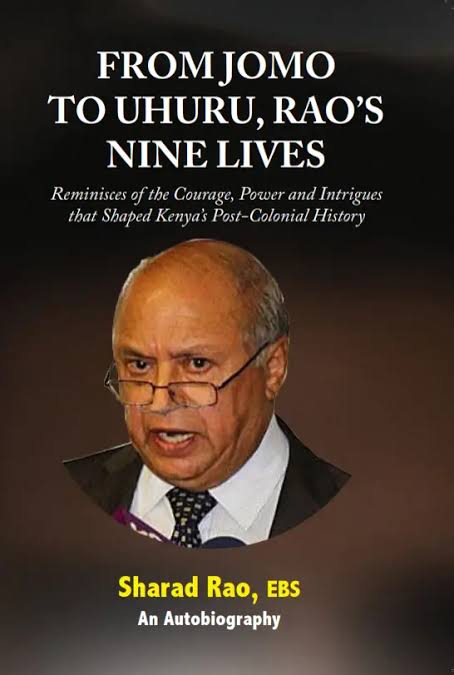
Book Review: From Jomo to Uhuru: Rao’s Nine Lives by Sharad Rao

By David Onyango
It is a rewarding experience to read the life story of a man who has watched four presidents come and go and lived long enough to write about all of them. All this with the steady hand of someone who has made peace with history and not settling scores. From Jomo to Uhuru: Rao’s Nine Lives is exactly that kind of book.
It chronicles Kenya’s political, judicial, and social transformation through the eyes of Sharad Rao, one of the country’s most distinguished legal minds, and it does so not as a dry historical record but as the testimony of a man who lived through every page of it. Having served under the administrations of Jomo Kenyatta, Daniel arap Moi, Mwai Kibaki, and Uhuru Kenyatta, Rao offers a unique insider’s perspective on the events and personalities that shaped post-independence Kenya.
One of the book’s greatest strengths is its unique mix of personal experience and national history, which makes the memoir feel less like a textbook and more like a long, unhurried conversation with someone who has earned the right to tell the story. Rao vividly recounts his journey as an Asian Kenyan navigating both colonial and post-colonial society, exposing the racial prejudices and political intrigues that influenced public life.
What makes these passages particularly moving is that Rao does not present himself as a flawless hero rising effortlessly above discrimination. He makes the reader feel the weight of exclusion, the quiet humiliations of being treated as an outsider in the only country he ever truly called home, while still showing how he pushed forward regardless. His reflections on judicial reforms, governance, and public service provide readers with valuable insights into Kenya’s fast evolving democratic institutions.
The autobiography is also enriched by Rao’s honesty, humour, and remarkable memory, qualities that give the book its very human pulse. He is just as willing to recount moments of frustration, disappointment, and even pettiness in the corridors of power as he is to recount his triumphs. Rao’s accounts of interactions with prominent leaders and his role in vetting judges after the 2010 Constitution offer an important record of Kenya’s constitutional development, but they are also laced with small, very human moments flashes of humour, irritation, pride, and even regret that remind the reader they are dealing with a real person and not a historical statue.
Reading the book, one gets the sense of sitting across from an elderly man at his home, the kind of person who pauses mid-story to laugh at his own memory before continuing, who may occasionally contradict the official version of events because he was there and remembers it differently, and who is not afraid to admit when he felt wronged or overlooked. This personal texture is what elevates the memoir beyond a simple recounting of dates and offices held; it gives the reader access not just to what Rao did, but to how it felt to live through it.
However, the book occasionally shifts between timelines, which may challenge readers seeking a strictly chronological narrative. At times, the reader must hold multiple threads of memory in mind simultaneously, as Rao moves between decades depending on which theme or reflection he is pursuing at that moment. This is, in many ways, how memory itself works: rarely linear and often associative. However, readers expecting a tidy, chronological account may occasionally need to slow down and reorient themselves. Despite this minor weakness, the memoir remains highly informative and compelling, and the occasional disorientation feels like a small price to pay for the intimacy and honesty the book otherwise offers.
Overall, From Jomo to Uhuru: Rao’s Nine Lives is an excellent autobiography that combines history, politics, and personal reflection in a way that feels genuine. It is a valuable resource for anyone interested in Kenya’s post-independence journey and the individuals who helped shape its institutions, but it is equally valuable simply as the story of one man’s long, complicated, occasionally painful, and ultimately dignified life.
Click here to get your copy of Sharad Rao’s From Jomo to Uhuru: Rao’s Nine Lives.
The writer is a research assistant at Free Press Publishers.