Support +254 734 916745

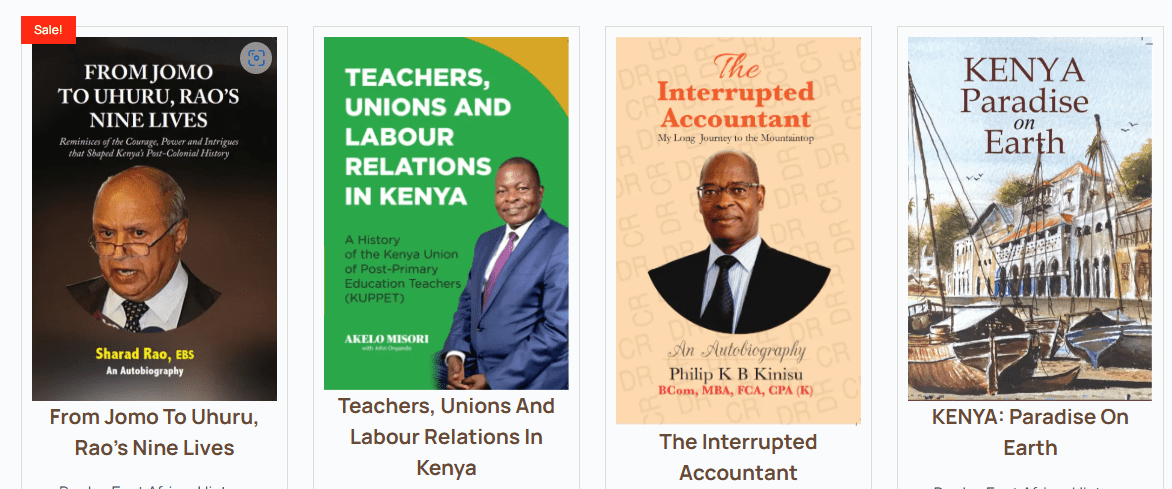
4 Must-Read Kenyan Memoirs That Tell the Story of a Nation

By David Onyango
Memoirs are one of the most prized materials in the literal world, with a majority of them coming from high-stature individuals in society. They preserve history, document social change, and offer relevant lessons long after the events themselves have passed. In Kenya, some memoirs stand out not only for the remarkable people behind them but also for the unique perspectives they provide on the country’s political, economic, and social evolution.
As a student of history, an aspiring leader, an entrepreneur, or lover of great life stories, the following books deserve a slot on your reading list:
1. The Interrupted Accountant by Philip Kinisu
Integrity is one of the most discussed but very rare virtues in Kenyan public life. In The Interrupted Accountant, former Ethics and Anti-Corruption Commission chairman Philip Kinisu offers a personal account of his journey from humble beginnings to the upper echelons of Kenya’s corporate and public sectors.
Far from being a conventional success story, the memoir explores the difficult choices, setbacks, and ethical dilemmas that accompany leadership roles. Kinisu’s reflections on his stint at the helm of Kenya’s Ethics and Anti-Corruption Commission (EACC) resonate very strongly in a country where graft scandals continue to cripple public services and social infrastructure.
What makes this memoir particularly compelling is its honesty. Instead of telling readers about a “flawless” path to success, Kinisu illustrates how his resilience, discipline, and character have been tested in moments of adversity.
Buy a copy of The Interrupted Accountant today.
Why read The Interrupted Accountant?
- Offers practical lessons on ethical leadership.
- Explores the realities of public service and corporate governance.
- Inspires young financial professionals confronting career and leadership challenges.
2. Teachers, Unions, and Labour Relations in Kenya by Akelo Misori
Few sectors have influenced Kenya’s development as heavily as its education sector. In Teachers, Unions, and Labour Relations in Kenya, veteran unionist Akelo Misori documents decades of struggles, negotiations, victories, and setbacks that have shaped labour relations in Kenyan education.
The memoir goes beyond the history of teacher unions. It tells a broader story about workers’ rights, collective bargaining, and the role organised labour plays in advancing social justice. Through firsthand accounts of policy battles and industrial actions, readers gain an insider’s perspective on how educational reforms have unfolded over the years.
At a time when labour rights and education reforms continue to dominate public discourse, Misori’s work serves as both a historical public record and a guide for future generations of union leaders.
Grab a copy of Teachers, Unions, and Labour Relations in Kenya today.
Why read this book?
- It provides rare insights into Kenya’s labour movement.
- The memoir details major education reforms and industrial relations milestones.
- It highlights the importance of collective action in democratic societies.
3. KENYA: Paradise on Earth by Dr. Ashraf Sheikh
While a good number of memoirs tell the story of an individual, others tell epic family stories. KENYA: Paradise on Earth accomplishes both while simultaneously capturing the fascinating multicultural heritage of Kenya.
Dr. Sheikh traces the exhilarating journey of the Sheikh Nurdin family from their migration into Kenya from Punjab in Asia, to their business success and community leadership. Along the way, the memoir explores the influence of Islamic faith, entrepreneurship, family values, and national belonging.
The book is particularly valuable because it reflects a side of Kenyan history that is often overlooked, the contribution of immigrant communities to the country’s economic and social development. Readers gain a deeper appreciation of the opportunities and challenges that have shaped modern Kenya.
Why read KENYA: Paradise on Earth?
- Celebrates a story of Kenyan entrepreneurship and family enterprise.
- Offers unique perspectives on migration and nation-building.
- Demonstrates the influence of faith in business and family life
Get a copy of KENYA: Paradise on Earth.
4. From Jomo to Uhuru, Rao’s Nine Lives – Sharad Rao
If Kenya’s post-independence history could be viewed from a front-row seat, Sharad Rao would be among the few qualified to narrate it.
In From Jomo to Uhuru, Rao’s Nine Lives, the veteran journalist and author reflects on decades of political, social, and economic transformation, spanning the administrations of Kenya’s first president, Jomo Kenyatta, through to the era of Uhuru Kenyatta.
Drawing from personal observations and extensive experience covering national affairs, Rao presents a compelling account of a country constantly reinventing itself. The memoir examines moments of uncertainty and the progress that continues to shape contemporary Kenya.
For readers seeking to understand how the nation arrived at its present moment, this memoir provides valuable context through the eyes of a seasoned observer.
Why read it?
- Offers a firsthand perspective on Kenya’s post-independence history.
- Explains major political and social developments in accessible language.
- Helps readers connect historical events to contemporary national issues.
Order a copy of From Jomo to Uhuru, Rao’s Nine Lives today.
The similarity in these four memoirs is they fit individual exploits within broader national discourse. Together, they form a compelling portrait of a nation in progress – its struggles, achievements, institutions, and people. For anyone interested in understanding Kenya beyond media headlines and textbooks, these memoirs offer an engaging and deeply human place to start.
The writer is a research assistant at Free Press Publishers.