Support +254 734 916745

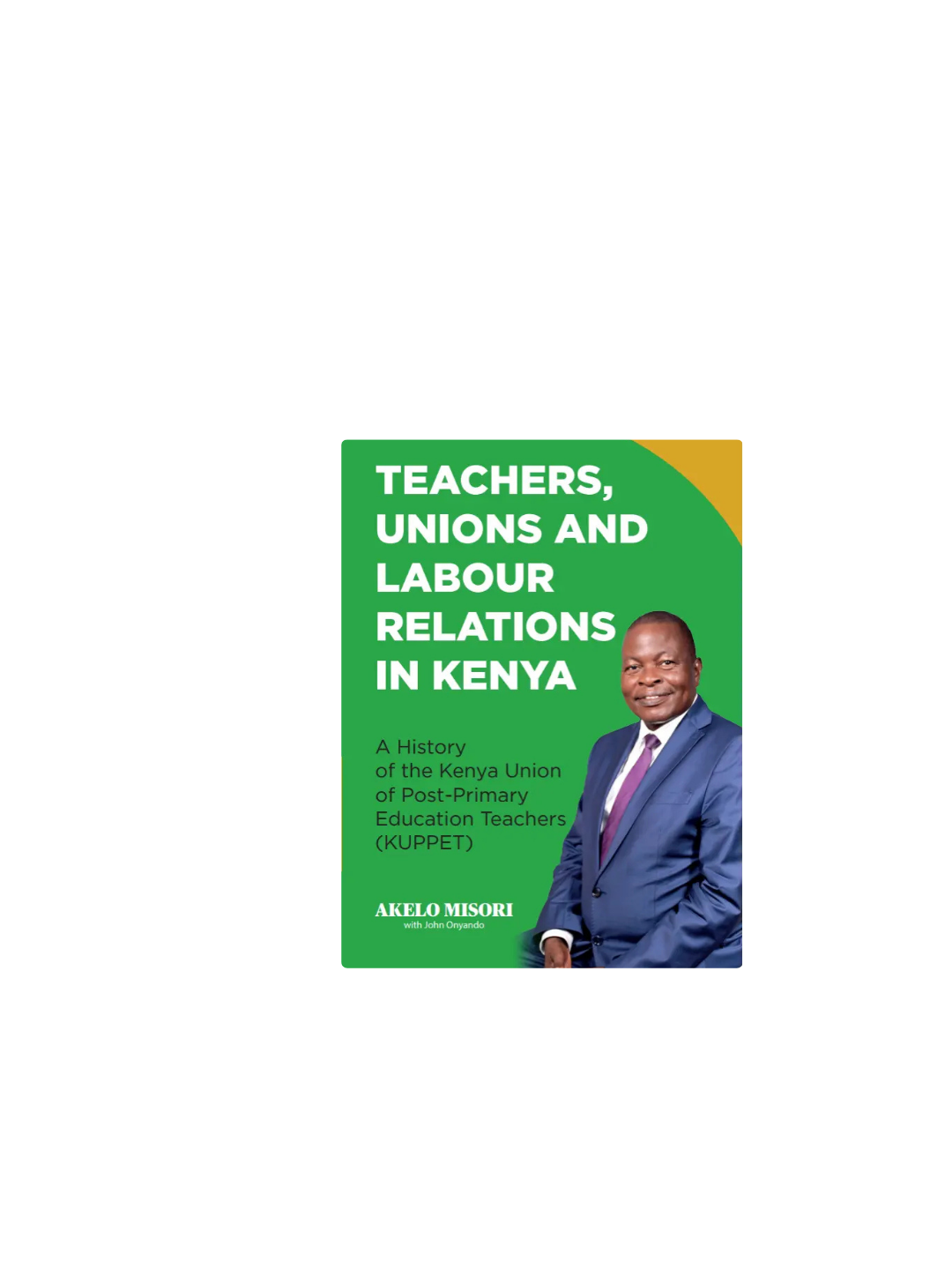
Akelo Misori Dissects Teacher Union Power Dynamics in Epic Memoir

By David Onyango
The Kenyan public is accustomed to high-stakes national politics. While mainstream campaigns for legislative and gubernatorial seats monopolize the headlines, a parallel, equally fierce spectacle unfolds within the country’s trade unions.
The frequent crossover of prominent labor bosses, mostly chairpersons and secretaries-general, into mainstream competitive politics continues to attract curiosity. This overlap begs a critical question: just how much leverage do these union leaders wield? Beyond the charged street protests and media briefings, what are the internal intrigues that govern the corridors of power within Kenya’s vibrant teachers’ unions?
In Teachers, Unions and Labour Relations in Kenya, Akelo Misori pulls back the curtain on the constant, calculated negotiation of power, influence, and constitutional authority. Misori maps out a complex system of competing and complementary forces shifting between executive dominance, grassroots resistance, and state interference.
The Duels at the Apex of Trade Unions
The book gives readers a behind-the-scenes of the historical structural tension baked into the union’s top two offices: the Secretary-General and the National Chairman.
The office of the Secretary-General commands substantial informal influence and massive public visibility, making the holder the functional face of the union. This position controls the day-to-day administration of the union, coordinates critical communication, and serves as the primary gateway to powerful external actors like the Teachers Service Commission, the Ministry of Education, and Parliament. Because of this direct access to executive execution and information, the Secretary-General operates as the true epicenter of daily union power.
Conversely, the National Chairman exercises authority primarily through the lens of constitutional governance and strategic oversight. Presiding over national meetings and ensuring strict adherence to procedural rules, the Chairman acts as a vital institutional brake designed to prevent an autocratic drift within the executive arm. However, because the Chairman does not manage the daily financial and administrative machinery of the union, the position can often appear less powerful to the public despite its immense constitutional significance.
This arrangement is theoretically intended to create a model of shared power. The book demonstrates that when the two high-profile officeholders pursue clashing political priorities, it could trigger severe operational friction.
The Grassroots Veto: Branches and the Delegates’ Conference
Power within the union machinery is partly anchored by volatile grassroot formations, through the influence of local Branch Executive Secretaries and Branch Chairpersons. Operating as political intermediaries on the ground, these local leaders hold the keys to mass mobilization. If national leadership loses touch with the rank-and-file membership, these branch officials can systematically choke the execution of national directives or industrial strikes.
The ultimate democratic counterweight to executive overreach is the National Delegates’ Conference. Bringing together elected branch representatives from all corners of Kenya, this conference holds the absolute mandate to amend constitutional provisions and dictate broad policy directions.
The Ultimate Adversary: The Union vs. The State
Beyond internal palace intrigues, the union exists in a permanent state of low-intensity conflict with the government and the Teachers Service Commission (TSC). Because the state holds an absolute monopoly over employment, teacher remuneration, and macroeconomic educational policy, labor relations become a permanent chess match of leverage.
National union leaders must carefully measure their steps. If they lean too hard into aggressive strikes, and the state can deploy legal sanctions, implement punitive deployments, or freeze the union’s primary revenue streams. If they lean too far into appeasement, and the grassroots membership will brand the leadership as sellouts, triggering an inevitable revolt at the next delegates’ conference.
Misori’s book has been touted as a manual on institutional statecraft. It demonstrates that the survival of any major labor movement relies on maintaining a sophisticated, highly calculated equilibrium of power across all tiers of governance.
Click here to get a copy of “Teachers, Unions and Labour Relations in Kenya.
The writer is a research assistant at Free Press Publishers.