Support +254 734 916745

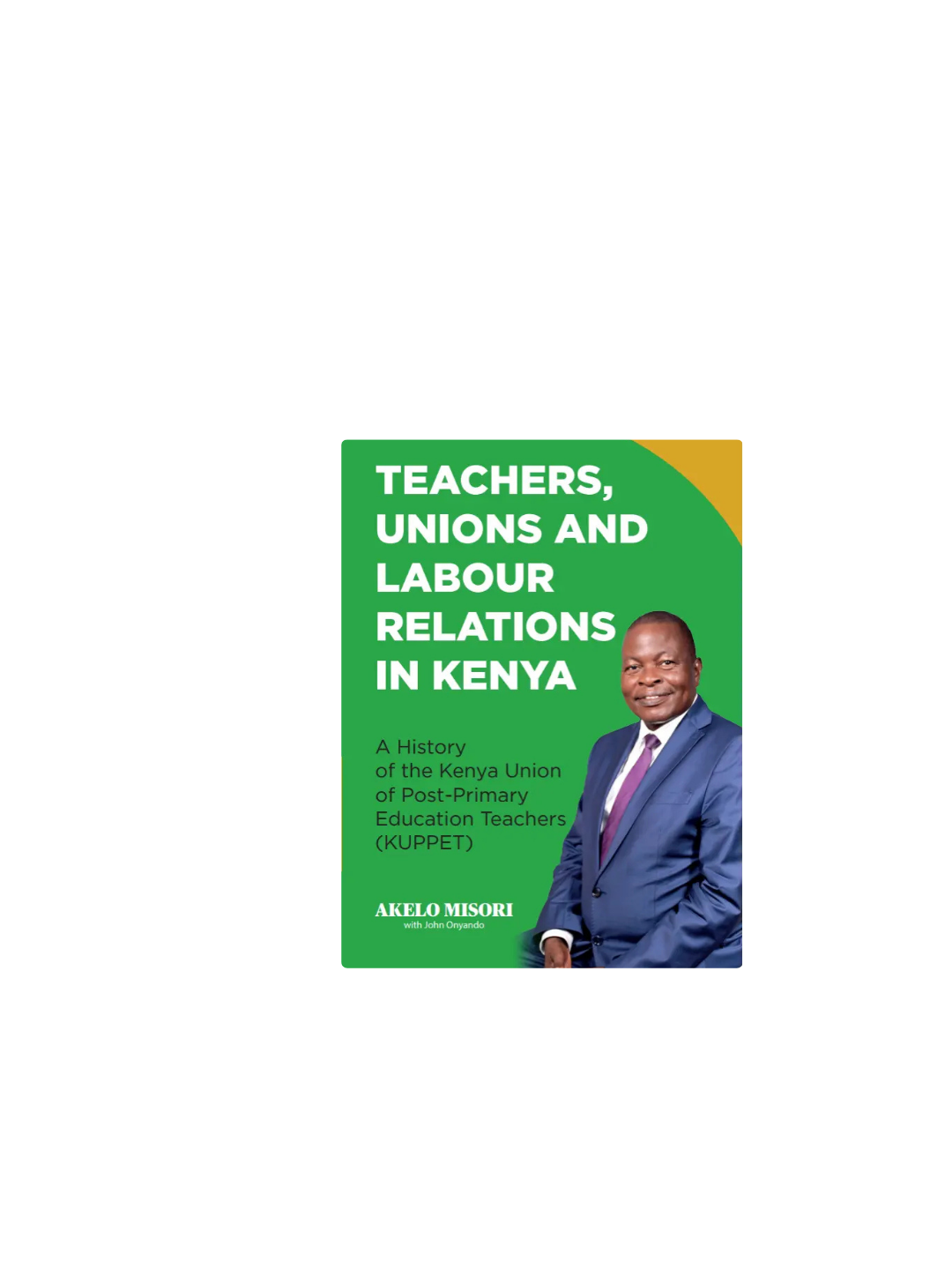
Akelo Misori Narrates Decades of Kenyan Education Reforms in Epic Book

By Jane Odeny
In Teachers, Unions and Labour Relations in Kenya, co-authors Akelo Misori and John Onyando provide an analytical, authoritative insider account of the tremendous changes that have occurred in Kenya’s education sector. From the immediate post-colonial structural overhauls to the rollout of the Competency-Based Curriculum (CBC), the book frames Kenya’s education sector as a highly dynamic and defined by radical reform, lofty national policy goals, and systemic teething problems.
From 7-4-2-3 to 8-4-4: Post-Independence Re-Engineering of Kenya’s Education
The narrative charts the immense structural changes that shaped post-independence Kenya. Under President Jomo Kenyatta, the immediate priority was eradicating ignorance while “Africanizing” a colonial schooling system to make it relevant to a newly sovereign state. This early foundation later gave way to the historic shift from the inherited 7-4-2-3 structure to the ubiquitous 8-4-4 system under President Daniel Arap Moi.
While these consequential policy shifts successfully democratized access to education and altered curriculum delivery, Misori and Onyando lay bare the immediate systemic shocks they caused. Each transition routinely triggered heavily backlogged teacher deployment schedules, severe classroom overcrowding, and acute resource deficits that directly threatened the quality of learning.
Kibaki’s Free Primary Education
The book offers a critical appraisal of President Mwai Kibaki’s legacy Free Primary Education (FPE) policy. While celebrated for exponentially increasing student enrollment nationwide and opening school gates to millions of underprivileged children, the reform severely tested the limits of the state’s capacity. Misori illustrates how this massive influx of students caught the Teachers Service Commission (TSC) off guard, drastically increasing teacher-to-student ratios and straining classroom infrastructure to its absolute breaking point.
The Turbulent Waters of CBC and Junior Secondary School (JSS)
Part of the book’s reform spotlight focuses on the rollout of the Competency-Based Curriculum (CBC), specifically the introduction of Junior Secondary School (JSS). Being one of the most radical structural transformations in Kenya’s history, JSS integrated Grades 7 through 9 into basic education with a strict pivot toward practical, skills-based learning.
However, the authors do not shy away from the intense anxieties this reform triggered across the sector. They meticulously document the profound logistical bottlenecks that emerged, including:
-
The Teacher Deployment Deficit: Acute staffing shortages and deep institutional confusion regarding how to transition and deploy teachers between primary and secondary school setups.
-
The Preparedness Gap: A stark deficit in specialized teacher training required to effectively deliver a radically technical and practical curriculum.
Tom Mboya’s Labour Reform Legacy in Kenya
The book fascinatingly traces the intellectual lineage of education and labour reforms back to pre-independence visionaries like Tom Mboya. By pioneering institutional collective organization and embedding workers’ voices into national decision-making, Mboya inadvertently set off the long cycle of education sector reforms in Kenya.
Teachers, Unions and Labour Relations in Kenya proves that while curriculum overhauls are always designed to improve learning outcomes, their success entirely hinges on the state’s ability to support the human capital tasked with implementing them.
The writer is a research assistant at Free Press Publishers.