Support +254 734 916745

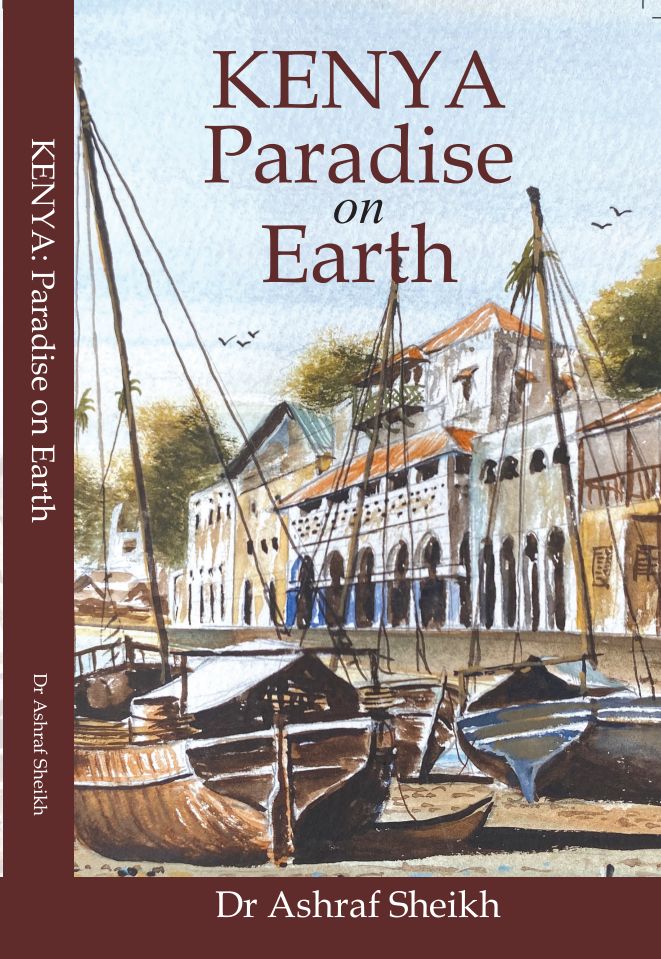
KENYA: Paradise on Earth: A Masterclass in Entrepreneurship and Generational Legacy

By Elijah Mbalaria
What if one of the most practical, honest, and inspiring books on entrepreneurship was not shelved in the business section, but hidden inside a multigenerational Kenyan-Asian family memoir set against the breathtaking landscapes of East Africa?
That book is KENYA: Paradise on Earth by Dr. Ashraf Sheikh.
At first glance, the book appears to be a historical and family narrative tracing the Sheikh Nurdin family’s journey across generations in East Africa. But beneath the story lies a blueprint for entrepreneurship, resilience, adaptability, and long-term vision. For entrepreneurs, business owners, professionals, and anyone trying to build something meaningful from limited beginnings, this book reads less like a memoir and more like a masterclass in enterprise building.
Sheikh Nurdin’s Bold Decision Sets Him on the Path to Becoming One of Kenya’s Wealthiest Men
Every entrepreneurial story begins with risk.
For the Sheikh family, that defining moment came in the 19th century when an ambitious young man named Nurdin left Punjab and travelled across the Indian Ocean toward an unfamiliar and unforgiving land in search of opportunity. There were no guarantees waiting for him in East Africa. There were no investors, roadmap, or safety net. The young man held on to his small savings and battled serious uncertainty as crossed the Indian Ocean passage towards Mombasa’s old port in Kibokoni.
Nurdin was fortunate to arrive and immediately embarked on setting up an export-import business at Mombasa. It evolved into a giant entreprise spanning different sectors of Kenya’s then nascent commercial space, with holding in other areas such as Nairobi and Northeastern Kenya.
Nurdin demonstrated the timeless qualities that still define successful entrepreneurs today: courage, vision, adaptability, and the refusal to allow fear to dictate the course of his life.
Every entrepreneur understands this moment. It is the moment where you stand at the edge of uncertainty and deciding whether to remain comfortable or venture into the unknown. Nurdin chose the unknown, and in doing so laid the foundation for a multigenerational legacy.
Spotting Opportunity Before Others Do
One of the most striking entrepreneurial lessons in the book emerges during the construction of the historic railway from Mombasa to Lake Victoria between 1896 and 1901.
The Sheikh family recognised a growing but underserved market among Indian labourers working on the railway project. Rather than waiting for opportunity to arrive, they positioned themselves where demand already existed and began creating value within that environment.
This is modern entrepreneurship in its purest form.
Long before the language of “market gaps,” “customer behaviour,” and “scaling strategy” became fashionable in polished business schools and startup accelerators, the Sheikh family was already applying these principles instinctively. They paid attention to people’s needs, adapted to changing conditions, and expanded strategically without losing sight of long-term stability.
The entrepreneurial approach outlined in this family story still mirrors the principles taught in modern business incubators today.
Profit With Purpose
What separates KENYA: Paradise on Earth from many conventional business books is its moral dimension.
The Sheikh family did not simply accumulate wealth. They used their success to build schools, mosques, community institutions, and support systems for those around them. Their business philosophy was rooted not only in survival and growth, but also in responsibility and service.
Today, corporate strategists would describe this as corporate social responsibility, community reinvestment, or brand trust. But long before such terminology became fashionable, the Sheikh family simply understood the value of integrity.
The family in return earned trust, goodwill, reputation, and lasting community as well as business relationships that money alone could never buy.
In today’s economy, consumers increasingly gravitate toward businesses they trust. Communities protect businesses that invest back into society, and integrity itself becomes a competitive advantage.
Entrepreneurship Evolves Across Generations
Another fascinating dimension of the book is how entrepreneurship changes form across generations while retaining the same underlying spirit.
Dr. Ashraf Sheikh himself represents this transformation. After earning his medical degree from King Edward Medical College in Lahore, he pursued advanced surgical training across Uganda, the United Kingdom, Scotland, Germany, South Africa, the United States, and Kenya.
Although the family’s entrepreneurial acumen ranges from trade and commerce into medical expertise and professional excellence, the values of ambition, discipline, movement, and mastery remains consistent.
The book subtly illustrates an important truth often ignored in entrepreneurship discussions: entrepreneurship is not limited to starting companies. It is also the pursuit of excellence, value creation, and legacy-building across professions and generations.
Whether one builds businesses, institutions, careers, or ideas, the entrepreneurial spirit remains remarkably consistent.
There is no shortage of business books promising formulas for success. Many offer theories, motivational slogans, or abstract frameworks detached from lived experience.
What makes KENYA: Paradise on Earth different is that it documents real people navigating real uncertainty across multiple generations. It is entrepreneurship observed not in theory, but in practice.
The story becomes especially powerful for:
- First-generation entrepreneurs searching for proof that long-term success is possible;
- Professionals trying to balance ambition with integrity;
- Business leaders interested in legacy-building; and
- Readers seeking a rich historical narrative intertwined with entrepreneurial insight.
More than a family memoir, KENYA: Paradise on Earth ultimately becomes a reflection on migration, enterprise, identity, leadership, and the enduring power of vision passed from one generation to the next.
The writer is a research assistant at Free Press Publishers.