Support +254 734 916745

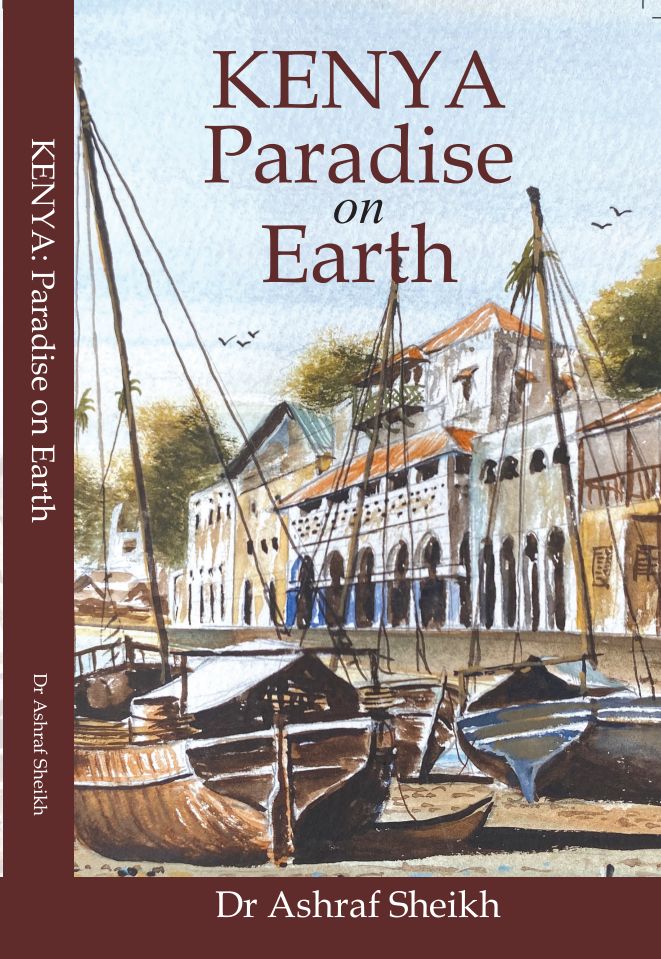
KENYA: Paradise on Earth – A Story of Adventure, Migration, and Opportunity in Kenya

By David Onyango
KENYA: Paradise on Earth, is a captivating memoir by a widely travelled orthopedic surgeon. The author, Dr. Ashraf Sheikh presents adventure not as leisure or spectacle, but as a defining force behind migration, enterprise, and cultural transformation. Through the multigenerational story of the Sheikh Nurdin family, Kenya emerges as an ideal place of settlement, a theatre of risk, discovery, and opportunity. The memoir offers a rare historical lens that resonates with today’s conversations on tourism, migration, and investment attraction in Kenya.
The adventure begins with Sheikh Nurdin’s late nineteenth-century journey from Punjab to East Africa. His decision to cross the Indian Ocean in search of opportunity was a bold act of uncertainty. Travelling by dhow to Mombasa exposed him to unpredictable weather, long voyages, and the ever-present fear of perishing at sea. The story brings out the essence of calculated risk-taking that still defines migration and investment today: the willingness to leave the familiar in pursuit of possibility.
Upon his arrival, Mr. Nurdin’s adventure shifts from travel to exploration. Kenya is portrayed as a land of striking natural beauty and immense contrast, with coastal ports, emerging towns, vast interior landscapes, and diverse communities. For the migrants, this was not a passive environment but an active space of adaptation and discovery. Their movement into new regions mirrors modern tourism narratives that position Kenya as a destination of natural wonder and cultural richness. However, the memoir goes further, showing Kenya not just as something to observe, but as a place to build a life.
This sense of adventure extends into economic enterprise. European settlers, alongside Indian natives engage in trade and business under colonial conditions marked by uncertainty and structural limitations. Starting and sustaining businesses required courage, adaptability, and long-term thinking. Their success demonstrates how risk, when combined with vision, can transform unfamiliar environments into thriving centres of economic activity. In this way, the memoir subtly reframes Kenya as an early frontier of entrepreneurship, an idea that aligns closely with its current positioning as a regional hub for investment.
However, the memoir does not romanticise adventure. It acknowledges the hardships of migration, including loneliness, discrimination, financial strain, and uncertainty. These struggles highlight that adventure is inseparable from sacrifice. However, it is precisely through these challenges that resilience and identity are formed.
In conclusion, the memoir reframes adventure as more than movement across space. It is a process of building, adapting, and investing in possibility. Read in today’s context, the memoir reaffirms Kenya as a land where tourism, migration, and investment still intersect, where those willing to embrace uncertainty can still find opportunity.
The writer is a research assistant at Free Press Publishers