Support +254 734 916745

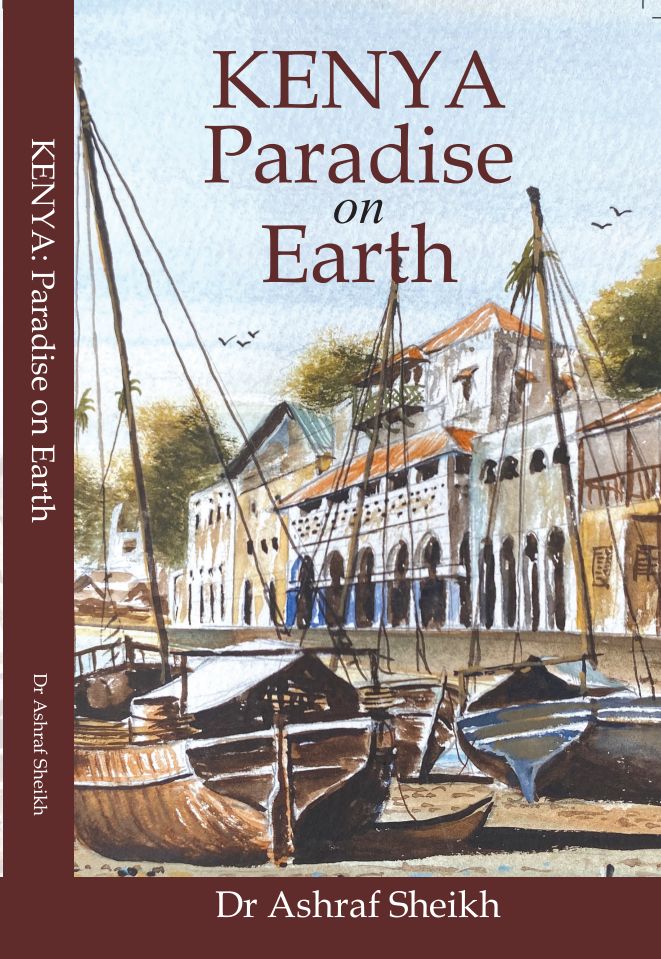
KENYA: Paradise on Earth – Limits of Conventional Education in Kenya

By Miriam Nyandika
In KENYA: Paradise on Earth by Dr. Ashraf Sheikh, education emerges as a central force shaping identity, opportunity, and intergenerational progress. Through the experiences of the Sheikh Nurdin family, particularly the migration from Punjab to East Africa, the author presents education not merely as formal schooling, but as a broader process of learning that encompasses values, survival skills, cultural adaptation, and personal discipline. In doing so, the book profoundly challenges the narrow framing of education as something confined to classrooms, examinations, and certificates.
At the heart of Dr. Sheikh’s memoir is the idea that education is transformative. Nurdin’s early life, as recounted in the family story, reflects the tension between youthful mischief and moral correction. A moment referenced in the story, where young boys are disciplined for stealing mangoes, becomes symbolic of a turning point. It marks the beginning of a journey from impulsive behaviour toward responsibility, discipline, and ambition. From these modest beginnings, the family story evolves into one of professional achievement, with members becoming doctors and respected figures in society.
Dr. Sheikh’s own trajectory reinforces this standpoint. His pursuit of medical education takes him across multiple countries, including Uganda, India, and the United Kingdom, reflecting a philosophy of learning that transcends borders. The idea that “knowledge should be pursued even if it means travelling across countries,” as echoed in the book, frames education as a global and lifelong pursuit rather than a fixed institutional stage. His career as an orthopedic surgeon, serving in diverse settings from hospitals to remote postings such as Lamu, further illustrates how education becomes meaningful only when it is applied in real-world contexts.
While the book celebrates formal education and professional excellence, it also implicitly raises important questions about how education is understood today. In many contemporary settings, including Kenya, education is often reduced to rigid classroom instruction, heavy examination workloads, and performance metrics that prioritise memorisation over lived understanding. This narrow approach risks producing learners who are academically qualified but insufficiently exposed to the realities of diverse social, cultural, and professional environments.
Although reforms such as the Competency-Based Curriculum (CBC) have been introduced to address these gaps by emphasising skills, creativity, and application, KENYA: Paradise on Earth clearly shows that more remains to be done. True education, as reflected in the family’s lived experience, is not only about passing exams but about developing adaptability, moral grounding, and the ability to navigate different worlds, cultural, professional, or geographical.
The book also highlights education as a tool for cultural adaptation and continuity. As the family settles in Kenya, education becomes the bridge that enables them to understand new languages, customs, and social systems while still preserving their cultural identity. This duality of learning to integrate while retaining roots demonstrates that education is both an outward and inward journey. It expands perspective while anchoring identity.
Equally significant is the role of family and community in shaping education. Across generations, from the patriarch Nurdin to Fazal to Dr. Sheikh and subsequent descendants, learning is not confined to formal institutions. Values such as discipline, respect, faith, and hard work are passed down through lived example and oral instruction. In this sense, the family itself becomes an educational institution, where moral formation is as important as academic achievement.
Ultimately, the book presents education as inseparable from personal development. Those who embrace learning are depicted as adaptable, resilient, and forward-looking. Education equips them not only to succeed professionally but also to contribute meaningfully to society.
In conclusion, KENYA: Paradise on Earth offers a layered understanding of education as transformation, continuity, and identity formation. Through the experiences of multiple generations, it demonstrates that education is most powerful when it extends beyond classroom boundaries into lived reality. While Kenya’s modern education reforms are moving in the direction of skills-based learning, the book serves as a reminder that true education must also prepare individuals to think globally, adapt culturally, and live responsibly in an interconnected world.
The writer is a research assistant at Free Press Publishers.