Support +254 734 916745

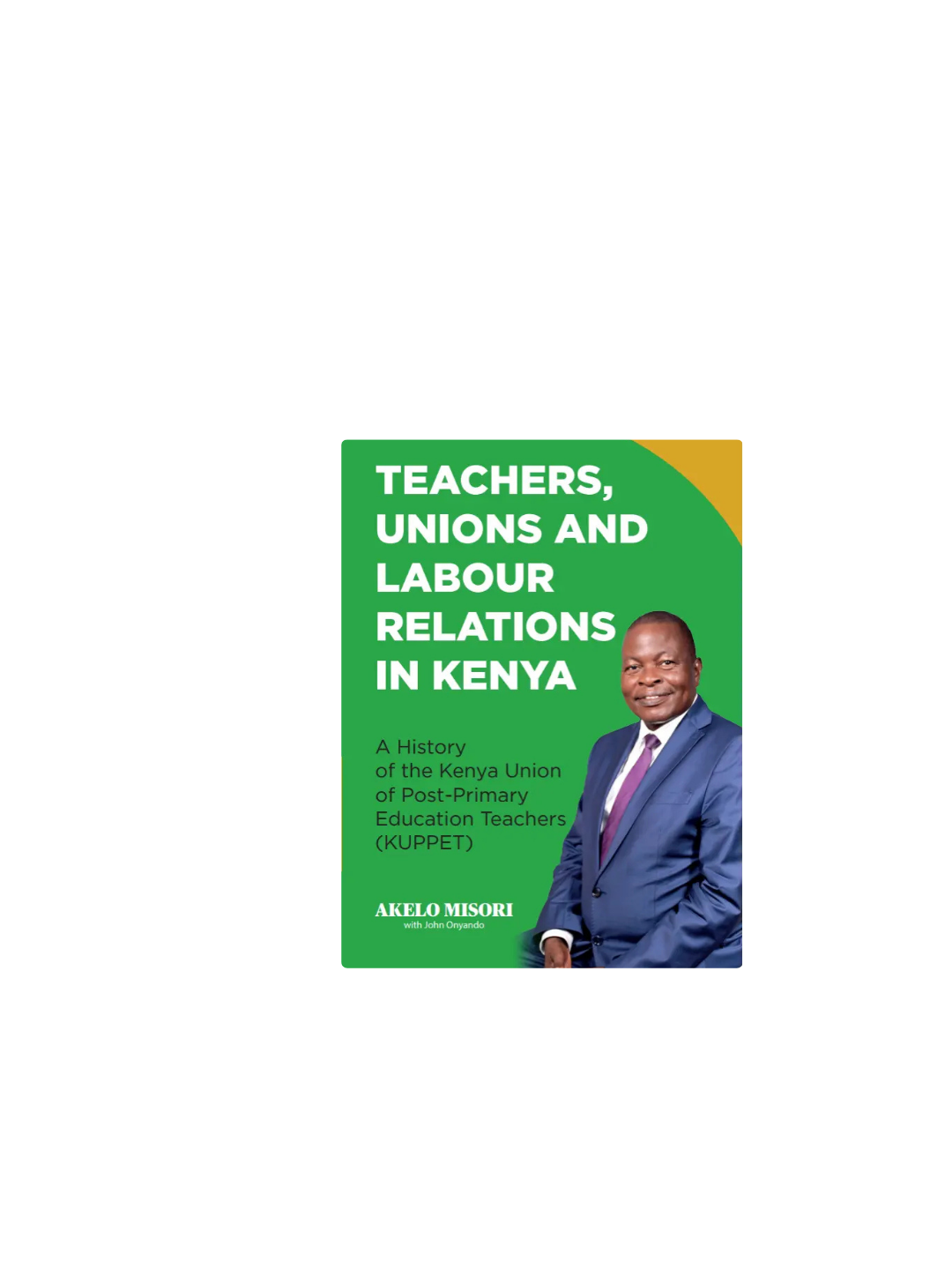
Labor, Laws, and Education: A Landmark Account of Kenya’s Teachers’ Unions

By Jane Odeny
Teachers, Unions and Labour Relations in Kenya is a compelling, authoritative account of the evolution of teacher unionism, labour relations, and the political issues surrounding educational development in Kenya. Authored by Akelo Misori and John Onyando, the book has emerged as the premier historical reservoir around the struggle for justice, professional dignity, and welfare within one of Kenya’s most respected and influential professions. Through a careful examination of historical developments, political dynamics, and labour activism, the authors illuminate the central role teachers have played not only in shaping education but also in advancing democratic governance, social justice, and nation-building.
The book traces the development of Kenya’s education system from the colonial era to the present day, demonstrating how colonial educational policies institutionalized racial segregation and inequality through separate systems for Africans, Asians, and Europeans. The authors convincingly show how these inequalities extended beyond education and laid the foundation for labour challenges that continued into the post-independence period. By situating teacher unionism within the broader history of educational transformation, the book offers readers a nuanced understanding of how historical structures shaped today’s labour struggles.
Misori and Onyando provide a detailed account of the expansion of formal education, the establishment of schools and teacher training institutions, and the indispensable contribution of teachers to Kenya’s social, economic, and political development. In addition to their commendable work in classrooms, teachers come out as agents of change whose efforts have been fundamental to national progress and human capital development.
A major strength of the book lies in its comprehensive analysis of trade unionism among teachers. The authors meticulously document the emergence and growth of the Kenya National Union of Teachers (KNUT) and later the Kenya Union of Post-Primary Education Teachers (KUPPET), illustrating how teachers organized collectively to advocate for better remuneration, improved working conditions, professional recognition, and meaningful participation in educational policymaking. The narrative highlights the numerous labour disputes, strikes, collective bargaining negotiations, and government responses that have shaped the trajectory of labour relations in Kenya’s education sector.
Particularly insightful is the book’s coverage of the complex factors that have influenced the teachers’ movement over the years. These include changing political environments, state-union relations, economic constraints, legal reforms, leadership transitions, internal union dynamics, and shifting educational policies. Readers get a rare glimpse into the multifaceted nature of labour relations and the enduring challenges faced by teachers in their pursuit of equitable treatment and professional respect.
The experiences of notable union leaders such as Tom Chariga and Buteyo enrich the book’s narration by providing a human perspective to the history of labour activism. Massively credited as union founders, their stories illustrate the courage, sacrifices, and resilience required to defend workers’ rights amid political interference, intimidation, institutional resistance, and intense confrontation with state authorities.
The authors also offer valuable insights into the relationship between KNUT and KUPPET, highlighting both the rivalry and cooperation that have shaped their efforts to represent different categories of teachers. More than presenting these unions as rivals, the book reveals how their interactions reflect the reality of representation, professional identity, and collective bargaining within the labour space in Kenya.
Drawing extensively on archival records, interviews, policy documents, and the authors’ personal experiences within the labour movement, Teachers, Unions and Labour Relations in Kenya stands out as an important contribution to Kenyan labour history. It successfully situates teachers at the centre of national development, showing how their struggles have influenced labour legislation, educational reforms, governance structures, and public policy.
This book will be particularly valuable to a wide range of readers. Scholars and students of education, labour studies, history, sociology, political science, and public policy will find it a rich source of empirical and historical material. Teachers, union officials, and education practitioners will gain a deeper appreciation of the origins of their rights, the sacrifices made by earlier generations, and the continuing challenges facing the profession.
Policymakers and government officials will benefit from the book’s insights into the dynamics of labour relations and the importance of constructive engagement between the state and professional organizations. Finally, the general public will gain a greater understanding of the often-overlooked struggles behind the welfare, recognition, and professional advancement of teachers.
By weaving the histories of education, labour activism, and national development, the authors have produced a key reference for anyone seeking to understand the trajectory of Kenya’s education sector.
The writer is a research assistant at Free Press Publishers.