Support +254 734 916745

Muhoozi’s Media Shutdown Signals an Escalating War on Press Freedom in East Africa

By Elijah Mbalaria
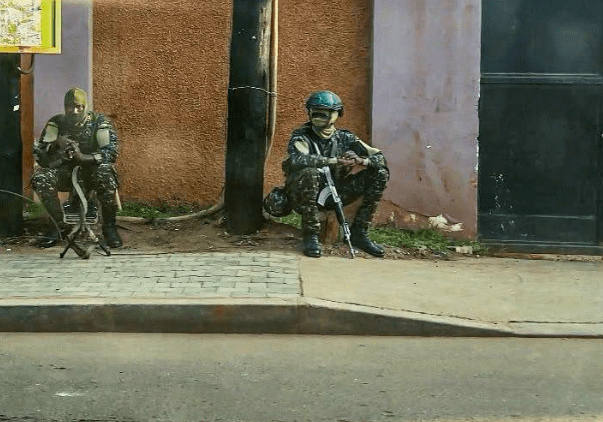
In the early hours of Sunday June 28, 2026, soldiers surrounded the Kampala headquarters of Nation Media Group. By sunrise, Uganda’s oldest surviving independent newspaper, the Daily Monitor, had armed men stationed at its gates. NTV Uganda and Spark TV, two of the country’s largest broadcasters, disappeared from television screens mid-transmission. Journalists who had worked through the night were also trapped inside the premises, and those arriving for work were turned away by soldiers.
The directive did not emerge from Uganda’s media regulator or a court of law. It was a direct order from the country’s military.
General Muhoozi Kainerugaba, Chief of Defence Forces, son of President Yoweri Museveni, and widely regarded as his political heir, announced the shutdown himself on social media. The Sandhurst-trained former special forces operative claimed that he did not believe in a free press and that all “negative” stories about Uganda would henceforth require clearance from his office before publication. He argued that the media should be guided by “cadres of the revolution,” language more reflective of a one-party dictatorial state than a constitutional republic that still conducts elections.
While the closure was shocking, it was not unprecedented. The Daily Monitor has previously been shut down, most notably in 2013 after reporting on the alleged “Muhoozi Project,” an alleged succession plan placing Museveni’s son at the centre of Uganda’s future leadership. NTV Uganda was forced off air in 2007 for coverage considered unfavourable to the government. The difference today is that the country’s seniormost military officer has installed himself as the editor of what citizens are permitted to know.
The consequences of this extend far beyond the walls of Nation Media Group Uganda. As one of East Africa’s largest media houses, Nation Media Group employs over 500 people comprising journalists, editors, camera operators, technicians and support staff in Uganda whose futures now hang in uncertainty. The Uganda National Broadcasters Association has condemned the shutdown as unconstitutional, but professional associations have very little leverage when soldiers enforce executive directives.
If one of the region’s largest and most established news organisations can be switched off overnight, no newsroom is beyond reach. The safest editorial policy then becomes self-censorship.
The unilateral decision by General Muhoozi also has far-reaching commercial consequences in Uganda. Advertisers typically hesitate to associate with outlets vulnerable to arbitrary closure, and investors inevitably begin pricing political interference into every media venture. Young journalists are now forced to enter a profession where survival depends on anticipating the sensitivities of those who wield state power, and not media ethics.
Uganda’s state gagging of the media is not an isolated case. Across East Africa, independent journalism is facing mounting political hostility, suggesting a broader regional trend.
In neighbouring Kenya, the Standard Media Group has found itself locked in an increasingly bitter confrontation with President William Ruto’s administration following sustained special reports covering the current government’s shortfalls. What began as a public war of words dramatically escalated into something far more disturbing.
On Saturday morning, June 27, 2026, Standard Group Associate Editor Alex Kiprotich narrowly escaped what appeared to be a foiled abduction attempt in Rongai, Nakuru County. According to his account, four armed men travelling in a Toyota Probox intercepted his vehicle. Sensing imminent danger, Kiprotich locked his doors, accelerated away from the scene, and escaped unharmed. Whether or not investigators establish responsibility, the incident sends an unmistakable signal to journalists across the region that the risks of critical reporting extend beyond professional reprisals to personal safety.
This emerging pattern should concern every East African citizen regardless of political affiliation. Democracy depends on informed citizens and elections lose meaning when voters cannot freely access information capable of holding those in power accountable. Courts also cannot effectively protect constitutional rights if abuses remain hidden from public view. While corruption flourishes most comfortably in darkness, authoritarianism advances gradually, normalising each new restriction until exceptional measures become routine.
A free press is one of democracy’s essential institutions, a public watchdog that enables citizens to scrutinise those who exercise power in their name. When journalists are intimidated, abducted, assaulted or prevented from publishing, the public loses ability to make informed political choices.
East Africa’s economies are increasingly integrated, and so too are its democratic fortunes. A region where governments discover that independent media can be intimidated without meaningful consequences risks creating a dangerous precedent that others may emulate. Authoritarian habits travel easily across borders, especially when they encounter little resistance.
The deterioration of press freedom also undermines East Africa’s international standing. Governments seeking foreign investment, stronger institutions and democratic legitimacy cannot simultaneously criminalise scrutiny. Investors value predictable legal systems and these do not thrive where journalism operates under the constant threat of closure or intimidation.
Reporters Without Borders has described 2026 as the bleakest year in the history of its global Press Freedom Index, with more than half of the world’s countries now classified as presenting “difficult” or “very serious” conditions for journalists.
When television screens suddenly go dark, newspapers stop printing, or journalists begin fearing for their safety, the immediate victims are media organisations. The long-term casualty, however, is democracy itself. As the old maxim reminds us, the price of democracy is eternal vigilance, and it is the independent media that most consistently performs that vigilance on behalf of society. When those watchdogs are silenced, democracy loses one of its strongest safeguards.
The writer is a research assistant at Free Press Publishers.