Support +254 734 916745

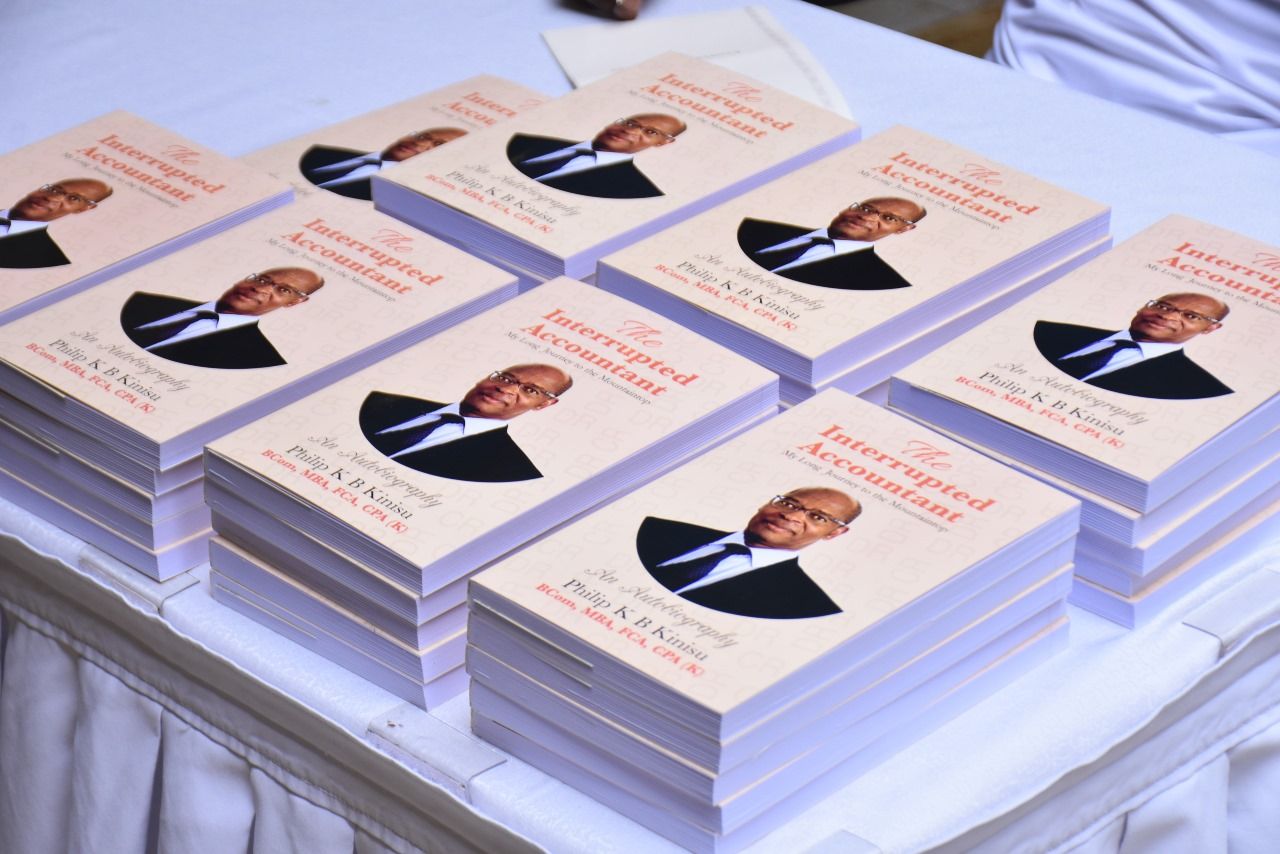
Philip Kinisu’s The Interrupted Accountant: The Discipline of Starting Over

By Elijah Mbalaria
Picture a man who spent thirty-five years climbing to the chairmanship of PwC Africa, later chaired one of Kenya’s most scrutinised anti-corruption agencies, and built, by almost every conventional measure, a distinguished career. That same man, however, describes his own life story as interrupted. Not successful, accomplished, or triumphant.
Philip Kinisu’s choice of title for his autobiography is revealing. It signals to the reader from the outset that The Interrupted Accountant: My Long Journey to the Mountaintop is no conventional executive memoir assembled to celebrate milestones and decorate a résumé. Instead, it is a rare exercise in candour, a story that refuses to airbrush failure, disappointment and personal upheaval in favour of glowing success. Philip Kinisu offers something rare among accomplished public figures: an honest account of the moments when life came apart and demanded that he begin again.
The story shows that the inconveniences that most people spend their lives trying to avoid often become the very experiences that shape character and life.
Kinisu’s interruptions start early in his life. Born into severe hardship in Malaha Village among the Bukusu community of Bungoma County, Kinisu’s journey into education was never assured. His path was punctuated by setbacks, including a spell in police custody while sitting his O-level examinations. At one point, he came perilously close to abandoning university altogether in favour of teacher training, a respectable but far more modest ambition.
At each crossroads, Kinisu could have settled for the easier outcome. Instead, encouraged by the steadfast determination of his mother, he persisted, eventually graduating top of his faculty with First-Class Honours in Commerce from the University of Nairobi.
The first interruption, then, was an invitation to lower his ambitions but he declined.
Battle for identity
The next interruption arrived thousands of miles from home, when he was invited to England following his brilliant exploits at the University of Nairobi.
Liverpool offered professional opportunity but also profound isolation. Pursuing Chartered Accountancy in England demanded more than academic excellence. It required adapting to an unfamiliar culture while confronting loneliness, uncertainty and the burden carried by many young Africans seeking professional legitimacy in institutions built far from home.
Those experiences shaped Kinisu as deeply as the accounting qualification itself.
Returning to Kenya, he embarked on a remarkable thirty-five-year career at Price Waterhouse and later PwC, rising steadily from junior auditor to Chairman of the PwC Africa Board. It would be easy to mistake this ascent as the destination. In the architecture of the memoir, however, it turns out as just a preparation. Every audit assignment, boardroom negotiation and leadership responsibility quietly equipped him for interruptions far greater than corporate life could ever present.
The infamous reputation crisis
The most deining obstacle in Kinisu’s journey to the mountaintop came with public service.
As Chairman of the Ethics and Anti-Corruption Commission, Kinisu stepped into one of Kenya’s most politically charged public offices, following earlier leadership roles at the National AIDS Control Council, Barclays Bank and major national infrastructure projects. His ambitious plan to reform the anti-graft body hit headwinds from powerful quarters.
The resultant adversarial tax assessments, relentless public scrutiny, allegations against businesses associated with him and intense media attention are narrated without any attempts at self-glorification or self-pity. Whether readers agree with every conclusion he reaches is beside the point. What these chapters show is the willingness of a man to revisit one of the most difficult periods of his public life with unusual openness.
Kinisu shows how quickly decades of achievement can be overshadowed by public controversy, and how resilience is measured not by avoiding such storms but by confronting them with integrity.
The Interruption of Home
Perhaps the book’s most personal, and most courageous, chapters are those that move beyond the boardroom.
Kinisu does not confine interruption to career setbacks. He also writes about the painful breakdown of his first marriage, a deeply personal loss that forced him to reconstruct not only his public life but his private one. For many public figures, such chapters are either omitted entirely or treated with careful vagueness.
He reflects on letting go of a marriage that had run its course, finding love again, remarrying and building a new family. There is no attempt to portray these experiences as easy or glamorous. Instead, he presents them in the broader maxim that sometimes life demands not simply perseverance but the humility to begin again.
It is this willingness to expose personal vulnerability alongside professional triumph that gives the autobiography much of its emotional credibility. Success, Kinisu reminds the reader, is rarely linear. Even those who eventually reach the summit sometimes have to descend, regroup and climb once more.
A Rare Memoir of Honest Failure
The Interrupted Accountant succeeds because it resists one of the biggest temptations of autobiographical writing: the urge to make every setback appear inevitable, every decision unquestionably wise and every success preordained.
Instead, Kinisu presents a life marked by uncertainty, disappointment, reinvention and recovery. Failed business ventures, public controversy, the collapse of his first marriage and the demands of rebuilding both career and family are not edited out of the story.
In an age when many memoirs are designed as curated exercises in reputation management, The Interrupted Accountant stands apart as a remarkably candid account of starting over. It reminds readers that challenges and success are one and the same.
Click here to get your copy of “The Interrupted Accountant” by Philip Kinisu.
Elijah Mbalaria is a research assistant at Free Press Publishers.