Support +254 734 916745
What is the Difference Between Book Publishing and Book Printing?

By Risper Atieno
One of the most common misconceptions we encounter when interacting with aspiring authors is the belief that a published book is simply a printed book. Authors typically send manuscripts and say, “I want this book published,” when what they often mean is, “I want this manuscript turned into printed copies that I can sell.” While the two things are related, they are not the same.
A published book and a printed book are products of different processes within the larger literary economy. Publishing involves developing, preparing, legally identifying, positioning, and bringing a work to its intended audience. Printing, on the other hand, is the physical production of copies for distribution and sale.
Understanding the difference between a publisher and a printer helps you understand what you are paying for, who is responsible for what, and why the cost of publishing a book may be different from the cost of printing it.
What Is a Publisher?
A publisher is an individual or organization responsible for turning a manuscript or idea into a book that can enter the market. Publishing is about content, rights, development, production decisions, and the business of bringing a book to readers.
The process often begins with identifying an author, commissioning a manuscript, acquiring an existing work, or working with an author who has already completed a manuscript. Once a work is accepted for publication, the publisher oversees the processes required to transform it into a professional publication.
These may include:
- Editing and proofreading the manuscript
- Structural and developmental editing where necessary
- Book interior formatting and typesetting
- Cover design
- Choosing the appropriate book format
- Obtaining an ISBN
- Addressing copyright and other intellectual-property considerations
- Preparing the book for print and/or digital publication
- Developing a marketing and distribution strategy
- Connecting the book with bookstores, distributors, online platforms, and readers
Depending on the publishing model, the publisher may invest in editing, design, production, marketing, distribution, and other aspects of bringing the book to market. The publisher may also negotiate with bookstores, distributors, institutions, online platforms, and other sales channels.
This is why the relationship between an author and publisher is very different from the relationship between an author and a printer. A printer is primarily providing a manufacturing service. A publisher is participating in the development and commercial life of the book.
In a traditional publishing arrangement, the publisher may acquire certain rights from the author and assume much of the financial risk associated with bringing the book to market. If the book sells poorly, the publisher may lose the money invested in the project.
In other publishing models, particularly collaborative or self-publishing arrangements, the author and publisher may share some of the costs and risks. The exact arrangement depends on the publishing agreement.
What Is a Book Printer?
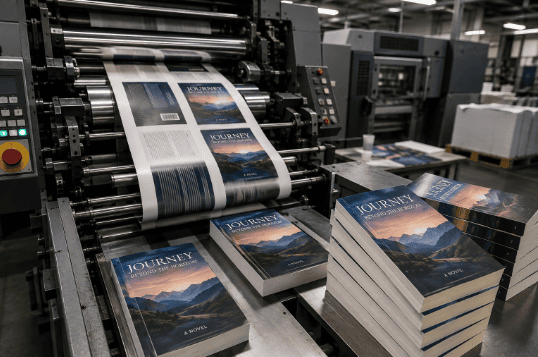
A printer produces physical copies of a book using files that have already been prepared for production. In industry terminology some professionals may refer to these files as “press-ready files.”
Once the manuscript has gone through the necessary editorial, design, and formatting stages, the publisher or author can provide the printer with print-ready files. The printer then converts those digital files into physical books.
The printing process involves:
- Selecting the appropriate print paper
- Setting up printing equipment
- Printing the interior pages
- Printing the cover
- Applying colour where required
- Binding the pages
- Trimming the finished book
- Applying finishing treatments
- Conducting production quality checks
- Packaging the finished copies
- Delivering the books according to the agreed instructions
A printer does not necessarily decide whether a manuscript is commercially viable, edit the author’s work, acquire publishing rights, market the book, or negotiate its distribution. Those responsibilities belong to the publisher or, in a self-publishing arrangement, to the author and the professionals they hire.
Is a Printed Book Automatically a Published Book?
Not necessarily. This is one of the most important distinctions for new authors to understand.
Imagine that you have written a 200-page novel. You send the manuscript to a commercial printer, and the printer produces 500 copies with a cover. You now have 500 printed copies.
But printing alone does not necessarily mean that the work has gone through all the processes associated with publishing. A professionally published book may require editorial work, typesetting, cover design, ISBN identification, copyright considerations, metadata, distribution planning, and other publishing activities before or alongside the printing stage.
The reverse is also true: a published book does not have to exist as a physical printed copy. An ebook can be published without a single sheet of paper going through a printing press.
Publishing Does Not Always Mean Printing
The growth of digital publishing has made the distinction even clearer. Publishers can release books in several formats, including:
- Paperback
- Hardcover
- Ebook
- Audiobook
- Digital editions for specific platforms
An ebook is published but not printed, and so is an audiobook.
Why Are Book Printing Costs Charged Separately?
Another common source of confusion for authors is the relationship between publishing costs and printing costs. An author may pay for editorial and design services and then wonder why producing the physical copies requires another payment. This is because the two are separate processes.
The physical characteristics of a book also affect its printing price.
For example, printing costs can change depending on:
- Number of pages
- Number of copies
- Paperback or hardcover binding
- Paper type and weight
- Black-and-white or full-colour interiors
- Cover finishing
- Book size
- Printing technology
- Delivery and packaging requirements
The number of copies is particularly important because commercial printing operates according to economies of scale. In general, larger print runs can reduce the unit cost, while very small runs may have a higher cost per copy.
For authors and organisations seeking to publish material, understanding this distinction is very important. A clear grasp of publishing, printing, distribution, costs, rights, and agreements can help you make better decisions and build more productive relationships with publishing professionals.
Read more about printing costs and the literary economy in Kenya.
The writer is a research assistant at Free Press Publishers.